Here’s the process I’ve developed in my own business over the past 21 years. If your budget is tight, you can DIY this, or hire me to guide you through it.
Sourcing your own candidate? For $495/candidate, I’ll provide a second set of experienced eyes.
Click on a step to expand the details.
Step 1: Discovery Call
We start with a free, 45-minute call to see if we’re a good fit.
Here’s a link to get on my calendar. Before booking, please review my current wait time, as new searches usually cannot begin immediately due to a waitlist.
During the discovery call, I’ll ask questions about the role for which you’re hiring, the kind of person you’re looking for, and, most importantly, the personality that will fit your office culture (and not drive you crazy!).
Step 2: My #1 rule
You must not “fall in love” with a candidate too early. Rushing always costs more time than being deliberate. The right hire is worth the wait.
All clients must agree to this before I start with them. We are hiring for the long term, not just filling seats with warm bodies.
That being said, my average time to find a candidate for you is 2-6 weeks.
Step 3: Getting started
If you decide to work with me, you’ll get an email with:
1. A short intake form to capture details about your business
2. An e-signable contract
3. An ACH/Credit Card link to make a $1,000 deposit
Step 4: Crafting the job ad
“You will find what you’re looking for, if you’re clear about what you’re looking for.”
Based on our discovery call and intake form, I will draft an ad outlining the ideal candidate. Of course, you’ll have the chance to tweak it before it is posted.
I post on Indeed.com because it’s the 29th most visited site in the world – home to the most candidates. Also, I can toggle the ad on and off to save you money (unlike sites that require a full month’s spend at double the cost).
How I Write job Ads (and Why I Don’t Use Corporate Jargon)
I start with a proven “base” job ad — but I never post it as-is.
Every market is different, and the best candidates respond to very different cues depending on where they live and what they’re used to seeing. This is more important than it might seem.
Corporate Jargon like “This role requires cross-functional alignment, proactive ownership, and the ability to execute high-impact initiatives while wearing multiple hats,” doesn’t tell candidates what the day-to-day will be like. Candidates want to understand what they’ll actually be doing.
When crafting the Indeed post, I think about the type of candidates in the area and how they tend to engage with job ads. In some markets, short and simple gets more traction. In others, candidates want more detail before they’ll take a role seriously. Small shifts in length, tone, and complexity can dramatically change who applies, and who doesn’t.
Next, I adjust the compensation and benefits based on the client. When a role includes health insurance or a company vehicle, application volume and quality jump noticeably. When those perks exist, I make sure they’re clearly highlighted rather than buried in the fine print.
And if there is a company car, I put it right in the headline. That single detail immediately signals that this is a legitimate, professional sales role It builds trust before a candidate even clicks.
Why This Works
Most job ads fail because they try to appeal to everyone. My approach does the opposite. By tailoring the message to the local candidate pool and leading with credibility signals that matter, the ad naturally filters out poor fits and attracts candidates who are more serious, qualified, and ready to succeed in the role.
Step 5: Screening Candiates
I review resumes and invite promising candidates to a one-way video screening (Click for an example). This allows me to invite more candidates to screen—especially those I’m on the fence about based on their resumes, but who might shine in person.
Those who complete the video are usually serious and about 70% advance to a 2-way Zoom interview with me.
Behavior during the process is often more telling than words:
How quickly they respond to my requests shows urgency.
How early they join the Zoom meeting shows punctuality.
Confirming the meeting or sending a follow-up shows intention.
Step 6: Assessments
I have most candidates complete a Caliper assessment because I might have a blind spot that I missed in the Zoom interview, but might be picked up on the Caliper.
I compare what they promise vs. what they deliver (for example, when they say they’ll complete the Caliper vs. when they actually do).
I review Caliper results and forward the strongest candidates to you, noting any who deserve consideration despite a moderate score.
I loop in Kristi Z., the Caliper expert at Corporate, to weigh in on the results.
If we are concerned about their technology skills, I will schedule a Zoom call with them to assess their ability to learn new technology.
I will send you a write-up of my thoughts on every candidate, along with a link to their one-way video. This way, you’ll be able to see and hear the candidate before interviewing them.
Unlike other recruiters, I NEVER coach candidates on how to act or dress when they meet you. If someone shows up to an interview in a backward baseball cap, you’ll see it — because that’s who they are. This approach helps avoid surprises once they’re on the job and ensures you’re choosing someone who fits your culture from the start.
Step 7: Interviewing
After I screen candidates, you’ll interview my “must sees” in-person (or virtually) and probe for weaknesses uncovered in the Caliper and skills necessary for the job.
Every candidate has weaknesses—we aim to choose the ones you can live with rather than be surprised by them later!
Next, someone close to you, like a Flight Group member or colleague, interviews them over Teams or Zoom to dig deeper.
Step 8: Extended Evaluation
Why such a long process? Candidates are on their best behavior at first. As the steps unfold, you get to see the real person.
Optional Ride-Along: Let the candidate experience the “messy” day-to-day. If they still want the job, they’re more likely to stick. This works especially well with production jobs – visit a job site together and have the candidate narrate what they are seeing, what they would fix, and how they might coach the crew.
Team Lunch: Have your team (without owners present) meet the candidate over pizza. Pay attention to what they ask and how your team reacts. You’ll be surprised how much your staff will will pick up on in this setting.
Rejecting candidates: It’s tough when a promising candidate drops out late in the process. It feels like starting over because you are. But this is part of hiring. You’re building a long-term team, not just solving today’s problem. Settling because you’re worn out will always come back to bite you.
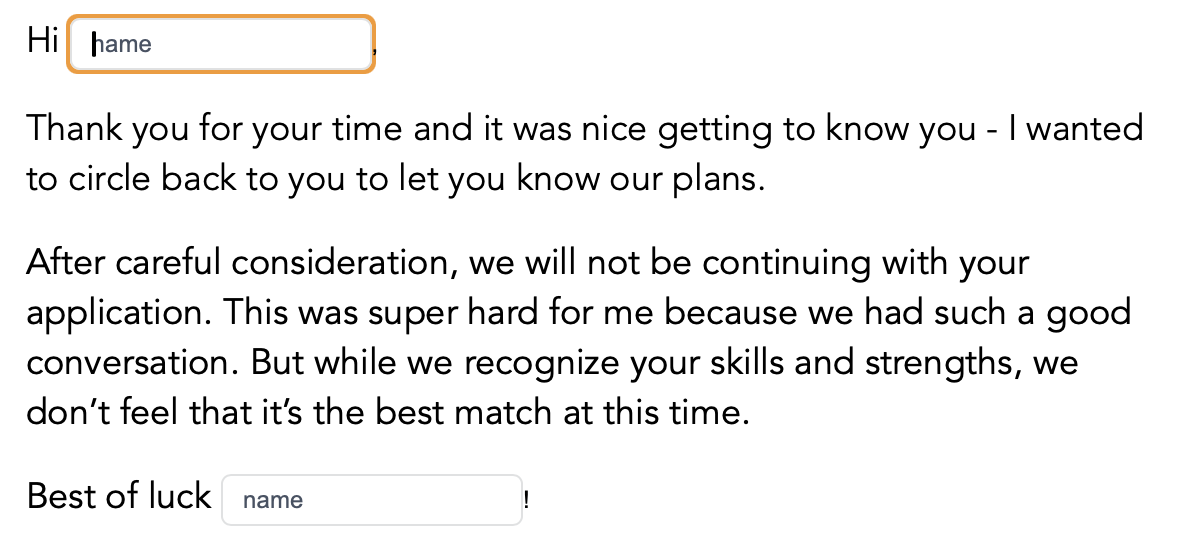
Click step 9 for my exact template for rejecting a candidate kindly.
Step 9: Nicely rejecting candidates
Remember, we are hiring for the long-term. This means candidates will need to get rejected along the way.
Here’s my exact wording:
Step 10: References, Background Check & Onboarding
I can help you gather references and arrange for you to call them to discuss the candidate.
Of course, the candidate is going to give us references who will say good things about them. What we want to know is something they might know that would make onboarding them smoother (“What do you know about Sally that would be helpful for me to know on the first day?”)
The Client does a background check. I recommend choosing a robust vendor and not opting for the least expensive package.
I provide an offer template for you to fill out and send before your phone review with the candidate.
I help ensure onboarding is tight with a clear job description.
I remind you to use Corporate’s 90-day onboarding videos.
Here is an example onboarding list I used in my business. It’s in Word so you can edit as you see fit. Note: this may not be 100% complete – your state/location may require different paperwork than is on this list.
 paigenejame.com